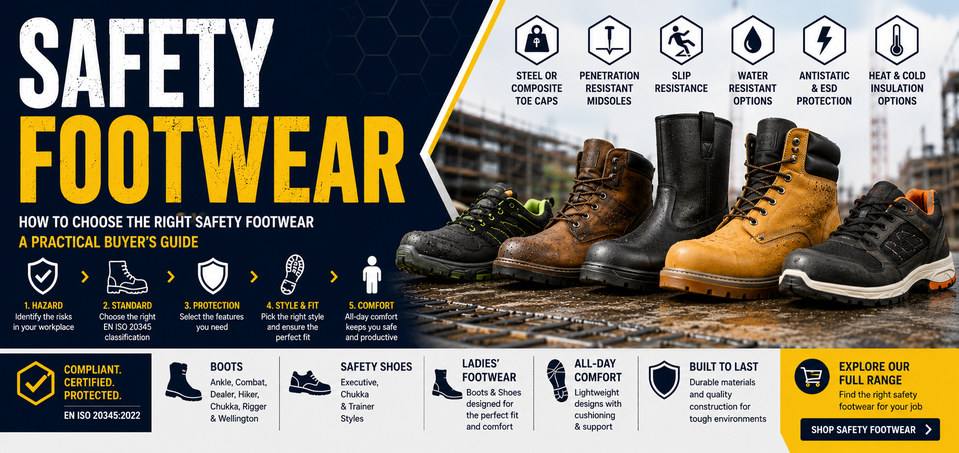
Safety footwear is about far more than simply adding a toe cap to a pair of boots.
The right footwear can help protect against hazards such as falling objects, puncture, slips, wet conditions, heat, cold, chemicals and electrostatic risks, depending on the product and its certification. HSE guidance also stresses that footwear should be selected for the actual risks present in the workplace.
This guide explains how to choose the right safety footwear, understand the main EN ISO 20345 markings and decide which style of boot or shoe is most suitable for the job.
Start with:
HAZARD → STANDARD → PROTECTION CLASS → STYLE → FIT → COMFORT → WORKING ENVIRONMENT
1. Start With the Hazard
Before choosing safety footwear, ask what the wearer actually needs protection from.
Common workplace hazards include:
- Falling or dropped objects
- Crushing and compression
- Sharp objects underfoot
- Slippery surfaces
- Water and wet conditions
- Heat or cold
- Oil and fuel
- Chemicals
- Electrostatic build-up
- Uneven terrain
- Long periods of standing or walking
A warehouse operative, construction worker, delivery driver and food-production employee may all require safety footwear, but they may need very different products.
Choose the footwear for the risk – not simply by appearance or price.
2. What Does EN ISO 20345 Mean?
EN ISO 20345 is the principal standard you will commonly see on safety footwear incorporating a protective toe cap.
The current EN ISO 20345:2022 standard introduced several changes to the way safety footwear is classified, including new protection classes and new markings for penetration resistance and slip performance.
You may therefore see newer footwear marked differently from older products that were certified under EN ISO 20345:2011.
That does not automatically mean one product is safer than another. Always check the complete certification and whether the footwear provides the protection required for the task.
3. What Does SB Mean?
SB represents the basic safety requirements under EN ISO 20345.
SB footwear includes a protective toe cap and the mandatory basic slip-resistance requirement under the 2022 standard.
Additional classifications build on these basic requirements.
4. Understanding S1 Safety Footwear
S1 footwear adds requirements including:
- Enclosed heel area
- Antistatic properties
- Energy absorption in the heel area
S1 footwear is commonly suited to many dry indoor working environments where toe protection and general workplace safety features are required.
5. What Are S1P, S1PL and S1PS?
These classifications add penetration resistance to S1 footwear.
Under EN ISO 20345:2022, the penetration-resistance markings are more specific:
P – metallic penetration-resistant insert tested with a 4.5 mm nail
PL – non-metallic insert tested with a 4.5 mm nail
PS – non-metallic insert tested with a smaller 3.0 mm nail
The smaller test nail used for PS creates a more demanding penetration test.
You may therefore see classifications such as S1, S1PL and S1PS.
6. What Does S2 Mean?
S2 builds on S1 and adds requirements relating to water penetration and absorption of the upper.
This can make S2 footwear useful where occasional exposure to moisture is expected but penetration-resistant midsoles are not required.
7. Understanding S3, S3L and S3S
S3 footwear combines many of the features buyers commonly look for in general industrial and construction footwear.
Depending on the specific classification, this includes:
- Protective toe cap
- Antistatic properties
- Heel energy absorption
- Water penetration and absorption requirements
- Penetration-resistant midsole
- Cleated outsole
Under the 2022 standard, you may also see:
S3L – using a PL non-metallic penetration-resistant insert
S3S – using a PS non-metallic penetration-resistant insert
These newer suffixes help identify exactly how the footwear’s penetration resistance has been tested.
8. What Are S4 and S5?
S4 and S5 generally relate to all-rubber or all-polymeric footwear, such as certain safety wellingtons.
S4 includes protective toe caps, antistatic properties and heel energy absorption.
S5 adds penetration resistance and a cleated outsole.
Newer versions can also use the suffixes S5L and S5S depending on the penetration-resistant insert used.
For wet environments, you can browse our Safety Wellingtons here.
9. What Are S6 and S7?
S6 and S7 are newer classifications introduced under EN ISO 20345:2022.
They relate to footwear with the additional WR whole-footwear water-resistance requirement.
Broadly:
S6 is based on S2-type protection with WR water resistance.
S7 is based on S3-type protection with WR water resistance.
You may also encounter S7L and S7S depending on the type of penetration-resistant insert.
10. What Happened to SRA, SRB and SRC?
If you have purchased safety footwear for years, you may be familiar with:
These markings were used under the older 2011 standard.
Under EN ISO 20345:2022, the old SRA, SRB and SRC markings are no longer used. Basic slip resistance is now incorporated into the standard, with an additional SR marking available where footwear passes the supplementary slip test.
This is important because older and newer products can display quite different markings while both remaining legitimate certified footwear.
11. Safety Footwear Does Not Automatically Mean Slip-Proof
This is worth emphasising.
HSE specifically warns that simply describing footwear as “safety footwear” does not necessarily mean it will provide suitable slip resistance for every surface or environment.
Slip performance can depend on:
- Sole design
- Sole material
- Floor surface
- Water
- Oil
- Grease
- Cleaning products
- Contamination
If slipping is a significant workplace hazard, choose footwear specifically suited to the floor and contaminants involved.
12. Steel Toe Cap or Composite Toe Cap?
Safety toe caps can be manufactured from different materials.
Steel Toe Caps
Steel toe caps are traditional, strong and widely used across industrial safety footwear.
Composite Toe Caps
Composite toe caps use non-metallic materials.
Potential advantages can include:
- Reduced metal content
- Potentially lighter construction
- Useful in some metal-free footwear designs
- Less thermal conductivity than metal
The important factor is not whether the cap is steel or composite, but whether the complete footwear achieves the required certified performance.
13. Steel Midsole or Composite Midsole?
The same principle applies to penetration-resistant midsoles.
Traditional designs may use steel plates, while newer footwear often uses textile or other non-metallic inserts.
Under the newer standard, the markings P, PL and PS help identify the type and test method used.
Metal-free footwear can be particularly attractive where lower weight, flexibility or reduced metal content is important.
14. Which Style of Safety Footwear Should I Choose?
Once you have established the safety requirements, you can think about the style.
Ankle Safety Boots
Ankle boots are one of the most popular general-purpose forms of safety footwear.
They provide greater ankle coverage than a shoe while remaining relatively lightweight and versatile.
Browse Ankle Safety Boots
Combat Safety Boots
Combat-style boots provide a taller, more substantial design and can be useful where additional ankle coverage and support are desirable.
Browse Combat Safety Boots
Dealer Boots
Dealer boots use a pull-on design without conventional laces.
They are popular where workers want footwear that is quick to put on and remove while still providing suitable workplace protection.
Browse Dealer Safety Boots
Hiker Safety Boots
Hiker-style safety boots combine workplace protection with styling and features influenced by walking footwear.
They can be particularly attractive to workers who spend much of the day walking or working across mixed terrain.
Browse Hiker Safety Boots
Chukka Safety Boots
Chukka boots provide a relatively compact ankle-height design and can offer a useful balance between the appearance of a shoe and the coverage of a boot.
Browse Chukka Safety Boots
Rigger Boots
Rigger boots are tall pull-on safety boots commonly used in construction, engineering and outdoor environments.
When choosing a rigger boot, look beyond the style and check the complete safety rating, fit and suitability for the task.
Browse Rigger Safety Boots
Safety Wellingtons
Safety wellingtons can be particularly useful in very wet, muddy or wash-down environments.
HSE guidance specifically identifies Wellington-style footwear as appropriate for very wet work where suitable protection is required.
Browse Safety Wellingtons
15. What About Safety Shoes?
Not every workplace requires a full boot.
Safety shoes can provide a lighter, lower-profile alternative where their certification meets the workplace risk assessment.
Executive Safety Shoes
Executive safety shoes are designed to provide workplace protection while maintaining a smarter appearance.
They can be useful for managers, engineers, drivers, site visitors and other employees who move between office and operational environments.
Browse Executive Safety Shoes
Chukka Safety Shoes
Chukka-style safety shoes offer a smart, practical option between a traditional shoe and a heavier safety boot.
Browse Chukka Safety Shoes
Safety Trainers
Modern safety trainers can look much more like sports footwear while still incorporating certified workplace protection.
They are increasingly popular in warehousing, logistics, manufacturing and other environments where lightweight, flexible footwear is preferred.
Browse Safety Trainers
16. Ladies’ Safety Footwear
Fit matters, and simply issuing a smaller version of a traditionally male-shaped safety boot is not always the best solution.
Foot shape, width and proportions can differ, so appropriately designed women's safety footwear can provide improved fit and comfort for some wearers.
For example, some manufacturers produce footwear on dedicated women's lasts rather than merely reducing the overall size.
You can browse our dedicated ranges of Ladies’ Safety Boots and Ladies’ Safety Shoes.
17. Waterproof or Water Resistant?
These descriptions should not automatically be treated as meaning the same thing.
Safety footwear may carry different water-related performance markings depending on its certification.
Under the newer standard:
WPA relates to water penetration and absorption of the upper.
WR relates to water resistance of the whole footwear.
S6 and S7 footwear incorporate the WR requirement.
If workers regularly operate in genuinely wet conditions, check the exact product specification rather than relying on marketing terms alone.
18. What Do Some of the Other Markings Mean?
Depending on the product, you may encounter additional markings such as:
A – Antistatic footwear
E – Energy absorption of the heel/seat region
HI – Heat insulation
CI – Cold insulation
HRO – Heat-resistant outsole
FO – Fuel/oil resistance
SR – Additional slip resistance
WR – Whole-footwear water resistance
AN – Ankle protection
M – Metatarsal protection
SC – Scuff-cap abrasion resistance
LG – Ladder grip
These additional markings allow footwear to be selected much more precisely for specialist applications.
19. Comfort Matters
Safety footwear may be worn for eight, ten or even twelve hours at a time.
Consider:
- Weight
- Width
- Toe room
- Arch support
- Cushioning
- Heel fit
- Breathability
- Flexibility
- Insole quality
- Temperature
- Terrain
The cheapest compliant boot is not always the best-value option if employees find it uncomfortable and avoid wearing it properly.
Think about cost per wear, not simply cost per pair.
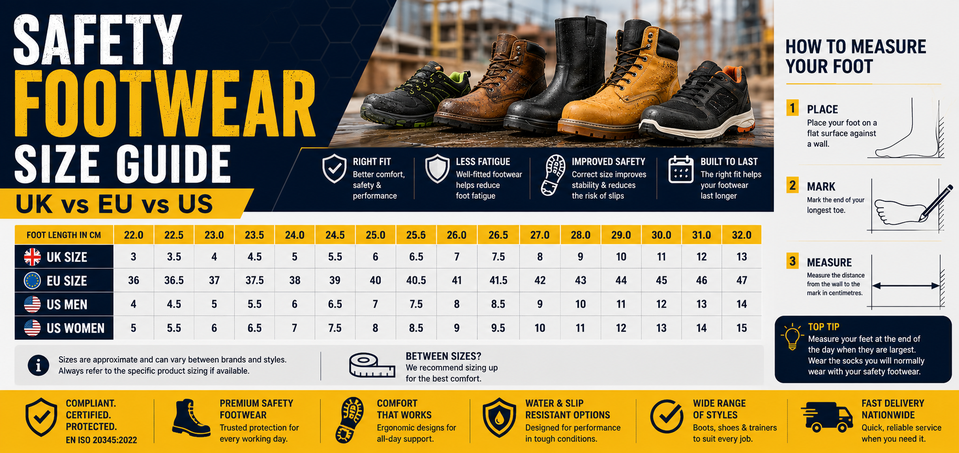
20. Get the Sizing Right
Poor fit can cause discomfort, rubbing, blisters and fatigue.
Footwear should provide enough room for the foot while still holding the heel securely.
Remember that:
- Different brands can fit differently
- Width can matter as much as length
- Work socks affect fit
- Feet can swell during the working day
- Different employees may require different styles
If you are changing footwear across a large workforce, samples or wearer trials can be worthwhile before committing to a large order.
The below chart will help if you are faced with converting EU or US shoe sizes to UK sizes...
21. Look After Safety Footwear
Safety footwear should be inspected and maintained in accordance with the manufacturer’s instructions.
Check regularly for:
- Split uppers
- Damaged soles
- Exposed toe caps
- Separation between sole and upper
- Worn tread
- Damaged fastenings
- Contamination
- Damaged penetration-resistant components
- Water entering footwear designed to resist it
Footwear that is badly damaged may no longer provide the protection stated when it was originally certified.
22. When Should Safety Footwear Be Replaced?
There is no single replacement period that applies to every safety boot or shoe.
Service life depends on:
- How frequently it is worn
- The working environment
- Surface conditions
- Moisture
- Chemicals
- Heat
- Wear and tear
- How it is cleaned and stored
Replace footwear where wear or damage may compromise its protective performance, and always follow the manufacturer’s guidance.
Safety Footwear Ordering Checklist
- What hazards are present?
- Which EN ISO 20345 classification is required?
- Is penetration resistance needed?
- Metal or non-metal penetration-resistant insert?
- Does the workplace have a significant slip risk?
- Is water resistance required?
- Do we need heat or cold protection?
- Are antistatic or other electrical properties required?
- Boot or shoe?
- Ankle, combat, dealer, hiker, chukka, rigger or Wellington?
- Would safety trainers be more suitable?
- Is metal-free footwear desirable?
- Have we considered ladies’ footwear and different fits?
- Will employees wear the footwear all day?
- Have we checked comfort and sizing?
- How will footwear be inspected and replaced?
Ready to Choose Your Safety Footwear?
Don’t start by asking:
“What’s your cheapest safety boot?”
Start with:
HAZARD → STANDARD → PROTECTION CLASS → STYLE → FIT → COMFORT → ENVIRONMENT
The best safety footwear is not necessarily the heaviest boot or the product with the longest list of markings.
It is the footwear that provides the appropriate protection for the workplace, fits the wearer correctly and remains comfortable enough to be worn throughout the working day.
Whether you need Ankle Boots, Dealer Boots, Hiker Boots, Rigger Boots, Wellingtons or Safety Trainers, start with the hazards and required performance, then choose the style that best suits the wearer and job.
And remember: safety footwear is PPE and forms the last line of defence. Workplace hazards should first be eliminated or controlled wherever reasonably practicable, with suitable PPE used where residual risks remain.