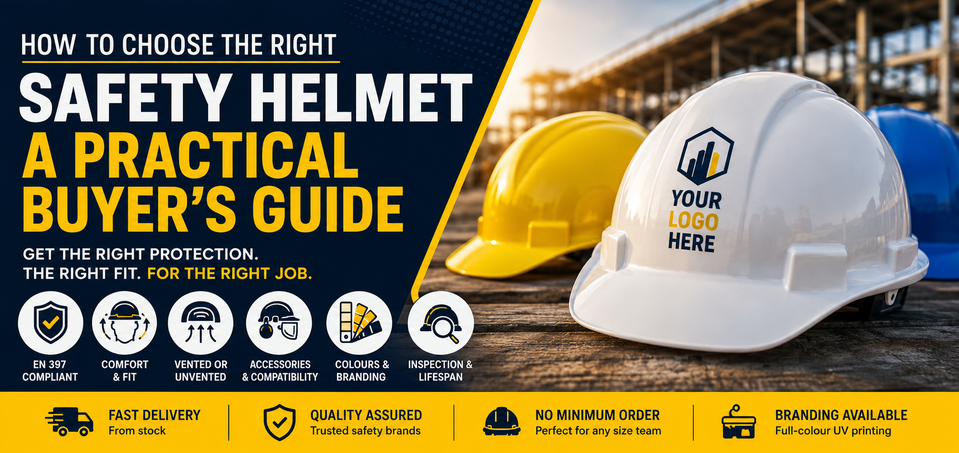
Choosing a safety helmet might seem simple. Find a hard hat, choose a colour and order the quantity you need.
In reality, there are several things worth checking before you buy.
The type of helmet, safety standard, fit, adjustment system, accessories and working environment can all affect which helmet is right for the job.
This guide explains some of the key things to consider when ordering safety helmets for yourself, your employees or your workplace.
1. Start With the Hazard – Not the Helmet
Before choosing a hard hat, consider what you actually need protection from.
Typical workplace hazards might include:
- Falling or flying objects
- Striking the head against fixed objects
- Penetration hazards
- Electrical risks
- Extreme temperatures
- Working at height
- Working around machinery or vehicles
A helmet being described as a "safety helmet" doesn't automatically make it suitable for every one of these situations.
Your workplace risk assessment should determine the protection required.
2. Check the Safety Standard
For general industrial safety helmets, one of the most commonly encountered standards is:
EN 397 – Industrial Safety Helmets
EN 397 specifies requirements for industrial safety helmets, including protection relating to impact and penetration.
Depending on the helmet, you may also see additional optional performance markings.
The important point is not simply to look for EN 397, but to check that the helmet's complete specification is appropriate for your workplace and risk assessment.
You can browse our range of safety helmets and hard hats here.
What About EN 12492?
You may also encounter helmets certified to EN 12492, a standard associated with helmets for mountaineers.
Helmet requirements can differ significantly depending on the intended application, particularly when it comes to features such as retention systems.
If you're purchasing helmets for specialist work or working at height, don't assume that an EN 397 industrial helmet and an EN 12492 helmet are interchangeable.
3. Check the Markings Inside the Helmet
Don't judge a safety helmet purely by its appearance. Look inside it.
Depending on the product, you should find important information such as the manufacturer, helmet type, applicable standard, size information and production information.
These markings help identify exactly what you're wearing.
Buying Tip: If you're responsible for PPE across a large workforce, keeping a record of the helmet manufacturer, model and relevant dates can make future inspection and replacement considerably easier.
4. Don't Forget the Date
Safety helmets don't last forever.
Materials can deteriorate through exposure to factors such as:
- UV light
- Heat
- Chemicals
- General wear
- Impact
- Poor storage
You may find manufacturing information moulded or marked inside the helmet.
However, don't automatically apply a universal "replace every X years" rule to every helmet.
Always follow the helmet manufacturer's recommended service life.
Different manufacturers and helmet materials can have different recommendations. A helmet should also be replaced sooner if the manufacturer's instructions require it following an impact, or if inspection identifies damage or deterioration.
5. Get the Right Size and Fit
A helmet can only do its job properly if it fits correctly.
Look for an adjustable head harness that allows the helmet to sit securely and comfortably.
Many modern helmets use a wheel ratchet adjustment system, making it easy for the wearer to fine-tune the fit. Other models use simpler adjustment systems.
For occasional use, a basic adjustment may be perfectly adequate. For somebody wearing a helmet throughout an entire shift, spending a little more on comfort can be worthwhile.
Our Tip: If you're ordering a new helmet for a large workforce, consider getting a few samples first. Let employees try them. A helmet that looks excellent in a catalogue isn't necessarily the helmet people will want to wear for eight hours.
6. Vented or Unvented?
Vented Helmets
Ventilation can improve comfort by allowing air to circulate around the wearer's head.
This can be particularly useful for people working outdoors, in warm environments, for long periods or during physically demanding work.
Unvented Helmets
An unvented shell may be required where particular hazards mean ventilation openings would be inappropriate.
The choice should therefore be based on the working environment and risk assessment, rather than comfort alone.
Our safety helmet range includes different helmet styles, allowing you to compare options before ordering.
7. Think About Accessories Before You Order
A common mistake is buying the helmet first and thinking about accessories afterwards.
Ask whether the wearer might also need:
- Ear defenders
- Face visor
- Eye protection
- Chin strap
- Neck protection
- Helmet-mounted lighting
- Other compatible PPE
If accessories need to attach directly to the helmet, check compatibility before ordering.
Don't assume it will fit. Accessory slots can look similar without necessarily making every manufacturer's accessory compatible with every helmet.
Using components specifically approved or recommended for the helmet is the safer approach.
8. What Colour Hard Hat Do You Need?
Safety helmets are available in a huge range of colours.
Colour can be useful for identifying different people or roles within a workplace, such as:
- Employees
- Supervisors
- First aiders
- Fire marshals
- Visitors
- Contractors
However, don't assume that a particular helmet colour automatically has the same meaning on every site.
Our Tip: If you're introducing a colour system, document it and communicate it clearly. There's little benefit in having six helmet colours if nobody knows what they mean.
9. Can You Put Your Company Logo on a Hard Hat?
Yes – and branded safety helmets can provide a professional appearance while making employees, departments and contractors easier to identify.
However, you shouldn't simply apply any sticker, adhesive, paint or other marking to a helmet without considering the helmet manufacturer's instructions.
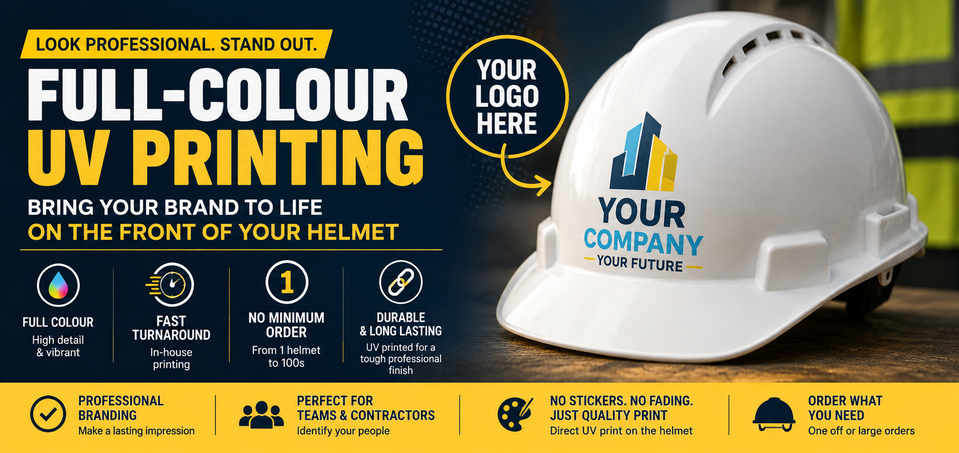
Full-Colour UV Printed Safety Helmets
We can now produce suitable full-colour branded safety helmets using direct UV printing.
This allows detailed company logos and other suitable personalisation to be printed directly onto the helmet, with no minimum order.
This means you can order a single personalised helmet for a new starter or replacement, as well as larger quantities for an entire workforce.
UV helmet printing is particularly useful for:
- Full-colour company logos
- Detailed branding
- Individual names
- Department identification
- Contractor identification
- Small quantities
- Large workforce orders
Want to see how it works? Read our guide to full-colour UV printed safety helmets.
10. Cheap Helmet or Premium Helmet?
Price matters – particularly when you're ordering hundreds of helmets.
But the cheapest helmet isn't automatically the best value.
Think about how the helmet will actually be used.
For occasional visitors, a straightforward compliant helmet may be sufficient.
For an employee wearing head protection eight hours a day, five days a week, features such as weight, ventilation, harness quality and ratchet adjustment can make a considerable difference.
Think cost per wear. Spending a few pounds more on PPE that is more comfortable and appropriate for the task can make sense when it is being worn every working day.
11. Inspect Your Helmets
PPE shouldn't simply be issued and forgotten.
Safety helmets should be inspected in accordance with the manufacturer's instructions.
Look for signs such as:
- Cracks
- Deep scratches
- Dents
- Deformation
- Damaged harness components
- Damaged straps
- Excessive wear
- Chemical contamination
- UV or heat deterioration
If you're unsure whether a damaged helmet remains safe to use, follow the manufacturer's guidance and replace it where required.
12. Store Safety Helmets Properly
How helmets are stored matters too.
Avoid unnecessarily exposing helmets to excessive heat, direct sunlight, chemicals or other conditions that could potentially degrade their materials.
Always follow the manufacturer's storage instructions.
Hard Hat Ordering Checklist
- What hazards are we protecting against?
- Which standard and performance requirements do we need?
- Is the helmet suitable for our working environment?
- Do we need a vented or unvented helmet?
- What adjustment system do our wearers need?
- Do we need chin straps, ear defenders or visors?
- Are all required accessories compatible?
- Which helmet colours do we require?
- Do we need company logos or individual names?
- What inspection and replacement procedure will we use?
If you can answer these questions, you're in a much better position to order the right helmet.
Ready to Choose Your Safety Helmets?
Don't choose a safety helmet based purely on price, colour or appearance.
Start with the hazard, identify the required standard and then consider fit, comfort, accessories and the working environment.
HAZARD → STANDARD → HELMET → FIT → ACCESSORIES → COMFORT → INSPECTION
When you're ready to order, shop our complete range of safety helmets and hard hats, with options available for workplace use and personalisation.
For personalised helmets, you can also find out more about our full-colour UV safety helmet printing service.
Remember: PPE is the last line of defence. It should form part of a wider approach to controlling workplace risks rather than replacing other appropriate control measures.