.png?lud=20260817090100)
When choosing Personal Protective Equipment (PPE), you will often see markings such as CE, UKCA, EN, BS EN and ISO.
But what do they actually mean?
This quick guide introduces some of the main conformity markings and standards used for everyday workplace PPE, covering head, eye, hearing, respiratory, face, hand and foot protection.
Important: The correct PPE should always be selected following an appropriate risk assessment and the manufacturer's instructions.
What Do CE, UKCA and EN Standards Mean?
CE = CE is a conformity marking showing that applicable European requirements have been addressed.
UKCA = UKCA is a UK conformity marking used where applicable for products placed on the Great Britain market.
EN / BS EN / ISO = These identify technical standards against which PPE has been designed and tested.
CE and UKCA are conformity markings, while EN / BS EN / ISO = Technical standards
Head Protection
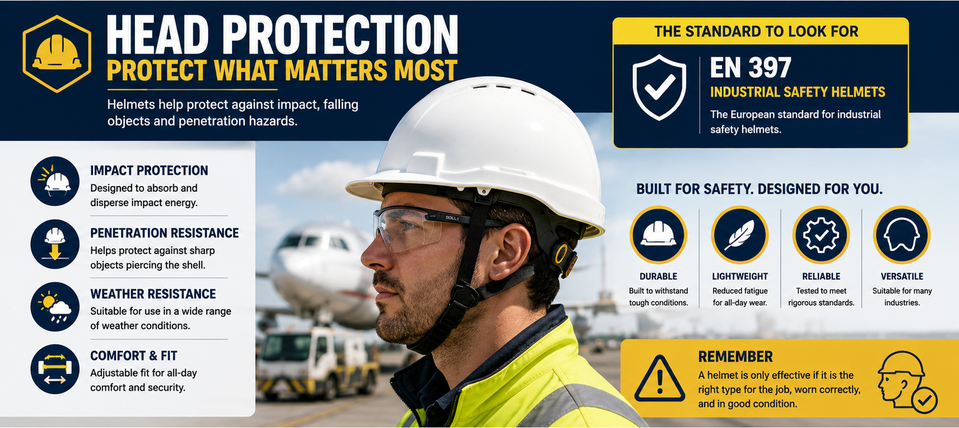
Industrial safety helmets help protect the wearer against hazards such as impact and penetration.
Common standard: EN 397
Different helmets are designed for different hazards, so always check the manufacturer's specification and workplace requirements.
Eye Protection
.png?lud=20260817115900)
Safety glasses and goggles can protect against hazards including flying particles, dust and splashes, depending on their tested performance.
Common standards: EN 166 / EN ISO 16321
The markings found on safety eyewear can provide important information about the type and level of protection offered.
Hearing Protection
.png?lud=20260817121600)
Ear defenders and ear plugs are used to reduce exposure to harmful workplace noise.
Common standard: EN 352
You will also often see an SNR rating on hearing protection. This provides an indication of the product's sound attenuation.
More protection is not automatically better. Hearing protection should provide suitable attenuation while allowing the wearer to communicate and remain aware of their surroundings where required.
Respiratory Protection
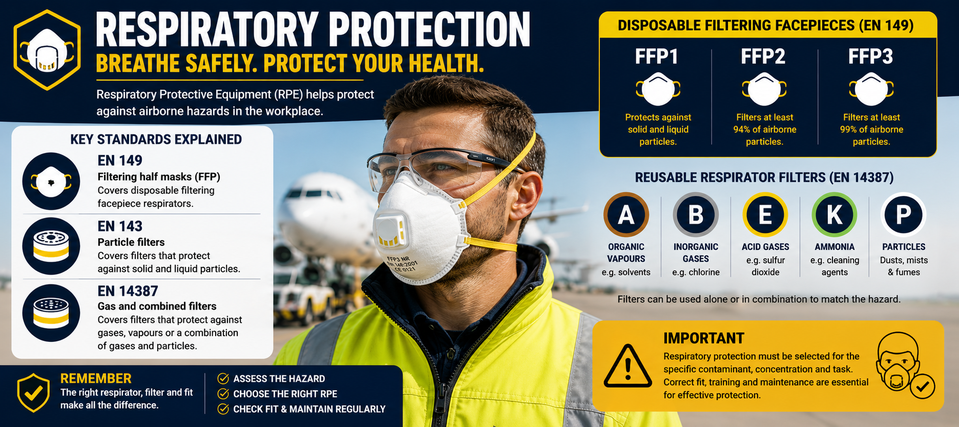
Respiratory Protective Equipment (RPE) protects against different airborne hazards depending on the respirator and filter being used.
EN 149 – Filtering half masks such as FFP respirators
EN 143 – Particle filters
EN 14387 – Gas and combined filters
Disposable filtering facepieces are commonly classified as FFP1, FFP2 or FFP3.
Reusable respirator filters may also carry markings such as A, B, E, K and P. These identify protection against different types of contaminants.
Important: Respiratory protection must be selected for the specific contaminant, concentration and task. Correct fit is also essential.
Face Protection
.png?lud=20260817124700)
Face shields and visors can protect against hazards such as impact and splashes, depending on their tested performance and certification.
Common standards: EN 166 / EN ISO 16321
A visor does not automatically replace safety glasses or goggles. Some tasks require both eye and face protection.
Hand Protection
.png?lud=20260817125300)
The markings and symbols shown on safety gloves help identify which hazards the gloves have been tested against.
EN 388 – Mechanical Risks
EN 388 covers protection against mechanical risks such as abrasion, cutting, tearing and puncture, with impact protection also identified where applicable.
EN 407 – Thermal Risks
EN 407 relates to gloves designed to provide protection against specified heat and flame hazards.
EN ISO 374 – Chemical Protection
EN ISO 374 covers protective gloves designed to provide protection against specified chemicals and microorganisms.
Foot Protection
.png?lud=20260817131000)
Safety footwear is designed to protect against workplace hazards such as impact, compression, slips and penetration, depending on its specification.
Common standard: EN ISO 20345
Additional markings can identify properties such as penetration resistance, water resistance, energy absorption and other protective features.
Choosing the Right PPE
A CE or UKCA mark alone does not tell you whether a product is suitable for a particular task.
When selecting PPE, consider five important factors:
1. Hazard – What are you protecting the wearer against?
2. Standard – Which PPE standard is relevant?
3. Performance – Does the PPE provide the required level of protection?
4. Fit – Does it fit the wearer correctly?
5. Application – Is it suitable for the actual working environment?
PPE Standards Made Simple
No single item of PPE is suitable for every hazard or every workplace. A product can conform to its stated standard while still being unsuitable for a particular task.
Understanding PPE conformity markings and standards makes it easier to identify the right protection for the job.
In our forthcoming guides, we'll look in more detail at safety helmets, eye protection, hearing protection, respiratory protection, face protection, safety gloves and safety footwear.