If you've ever bought a hi-vis vest, jacket or pair of trousers, you've probably seen EN ISO 20471 mentioned in the product description or printed on the label.
But what does it actually mean?
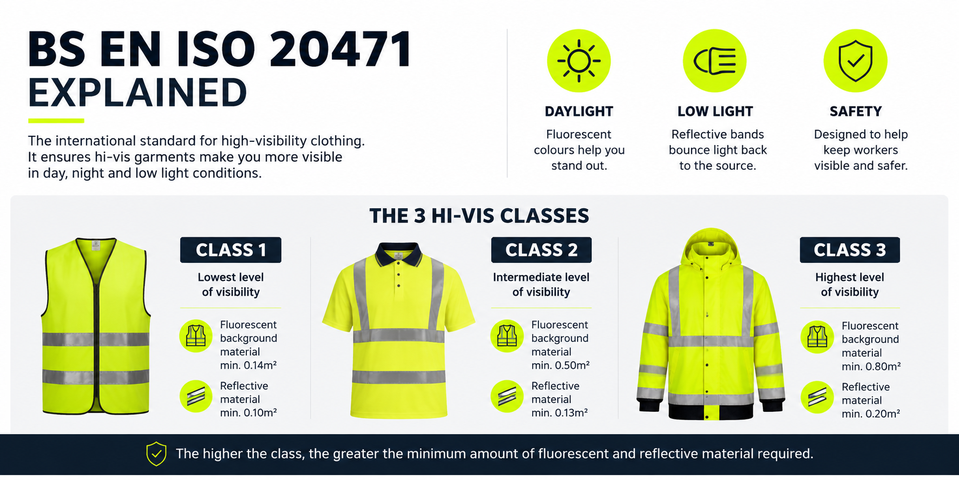
BS EN ISO 20471 is the standard used for high-visibility clothing designed to make the wearer easier to see in potentially dangerous situations.
It sets rules covering things such as the amount of fluorescent material and reflective material a garment needs to have.
Most importantly, it divides hi-vis clothing into three classes: Class 1, Class 2 and Class 3.
What Does EN ISO 20471 Protect You From?
Hi-vis clothing has one main job:
To make you easier to see.
During daylight, the bright fluorescent material helps you stand out against your surroundings.
At night or in poor light, the reflective bands reflect light from sources such as vehicle headlights, making the wearer much more visible.
This is particularly important for people working around:
- Moving vehicles
- Construction equipment
- Forklift trucks
- Roads and highways
- Airports and airfields
- Railways
- Warehouses and distribution centres
- Building sites
- Delivery yards
What Are the Three Hi-Vis Classes?
The easiest way to understand the classes is:
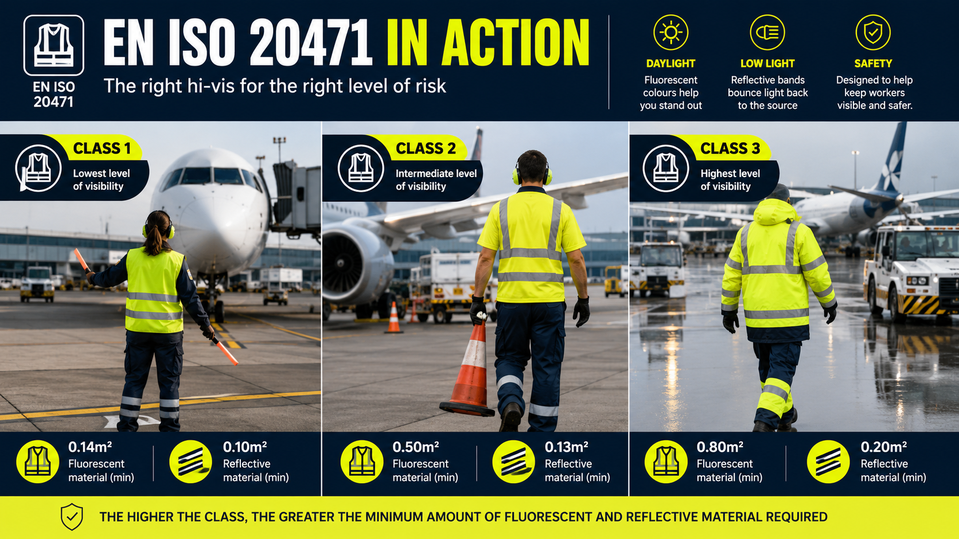
Class 1 = Lowest visibility level
Class 2 = Intermediate visibility level
Class 3 = Highest visibility level
The class isn't simply a measure of how "good" a garment is.
A major factor is how much compliant fluorescent and reflective material the garment provides.
Class 1
Class 1 provides the lowest level of visibility within the standard.
It may be suitable for some lower-risk situations, but it shouldn't automatically be assumed to be suitable for every workplace.
Class 2
Class 2 provides an intermediate level of visibility.
Many hi-vis garments fall into this category, including numerous hi-vis waistcoats, tops and other garments.
It provides more visible material than Class 1.
Class 3
Class 3 provides the highest level of visibility within EN ISO 20471.
It is commonly required where workers need maximum visibility because of their working environment or the risks around them.
Class 3 garments need considerably more visible material than Class 1 or Class 2 garments.
This is one reason why larger garments such as hi-vis jackets can often achieve Class 3 more easily than a simple sleeveless waistcoat.
How Much Material Is Required?
The standard specifies minimum areas of visible material.
| Classification |
Fluorescent Background Material |
Reflective Material |
| Class 1 |
0.14 m² |
0.10 m² |
| Class 2 |
0.50 m² |
0.13 m² |
| Class 3 |
0.80 m² |
0.20 m² |
This helps explain why the design and size of a hi-vis garment matter.
More coverage can mean a higher visibility classification.
Why Is Hi-Vis Usually Yellow or Orange?
The bright part of a hi-vis garment isn't just ordinary brightly coloured fabric.
EN ISO 20471 specifies requirements for fluorescent background materials designed to provide high visibility during daylight.
The familiar fluorescent yellow and orange-red colours are therefore functional parts of the garment rather than simply a fashion or branding choice.
What Do the Silver Reflective Bands Do?
The silver-looking strips on hi-vis clothing are retroreflective material.
When light hits this material, much of that light is reflected back towards its source.
Imagine a vehicle approaching a worker at night. The vehicle's headlights hit the reflective bands and the reflected light helps the driver identify the person much earlier than they might if the worker were wearing ordinary clothing.
That's why the position, width and amount of reflective material matter.
Can Adding a Company Logo Affect EN ISO 20471?
Potentially, yes.
This is something businesses should consider when adding logos, names or other decoration to hi-vis PPE.
A large print or embroidered logo can cover some of the fluorescent background material. Decoration should also avoid interfering with the garment's reflective bands.
This is particularly important when large logos are being applied to the back of a garment.
When personalising hi-vis clothing, the decoration needs to be considered alongside the garment's certified design and intended use.
Does Wearing a Hi-Vis Vest Automatically Mean You're Compliant?
No.
A garment being bright yellow or orange doesn't automatically mean it complies with EN ISO 20471.
Look at the product specification and garment information to check its certification and classification.
You also need to make sure the selected clothing is appropriate for the job being carried out.
Which Class Do I Need?
There isn't one answer for every workplace.
The correct hi-vis clothing should be selected according to the risk assessment and working environment, including factors such as traffic, vehicle speeds, lighting conditions and the type of work being undertaken.
Some industries and workplaces also have additional rules or specifications.
For example, someone working on or near a public highway may have different requirements from somebody wearing hi-vis in a warehouse.
Don't simply assume that Class 3 is always necessary or that Class 1 or Class 2 will always be sufficient.
The Easiest Way to Remember It
If all the technical terminology is confusing, remember:
EN ISO 20471 = a recognised standard for professional high-visibility clothing.
Class 1
Lowest visibility level
Class 2
Intermediate visibility level
Class 3
Highest visibility level
The higher the class, the greater the minimum amount of fluorescent and reflective material required.
Buying EN ISO 20471 Hi-Vis Clothing
When buying hi-vis workwear, don't choose a garment based purely on price or colour.
Check:
- The EN ISO 20471 certification
- Whether it is Class 1, Class 2 or Class 3
- Whether that classification is suitable for your workplace
- Any additional industry-specific requirements
- Whether adding logos or personalisation could affect the compliant visible areas
At HiVis.net, we supply a huge range of professional hi-vis clothing for workplaces across the UK, with options for adding your company logo using DTF printing or embroidery.
If you're unsure which type of hi-vis clothing you need, contact our team and we'll be happy to help.
In one sentence:
BS EN ISO 20471 tells you that a hi-vis garment has been designed and tested to defined visibility requirements — and its Class 1, 2 or 3 rating tells you the level of visibility it provides.
```